
The year 2026 finds Escape From Tarkov still standing as a brutal monument to hardcore survival shooters. Its grim corridors and rain-soaked industrial districts have witnessed countless firefights, desperate loot runs, and the silent dread of permadeath for your gear. Yet, one specter has clung to Tarkov's shadowed walls for over a decade: the relentless plague of cheaters. Looking back, the frustration of the early 2020s feels like a distant thunderstorm, but the echoes still rumble through the community today.
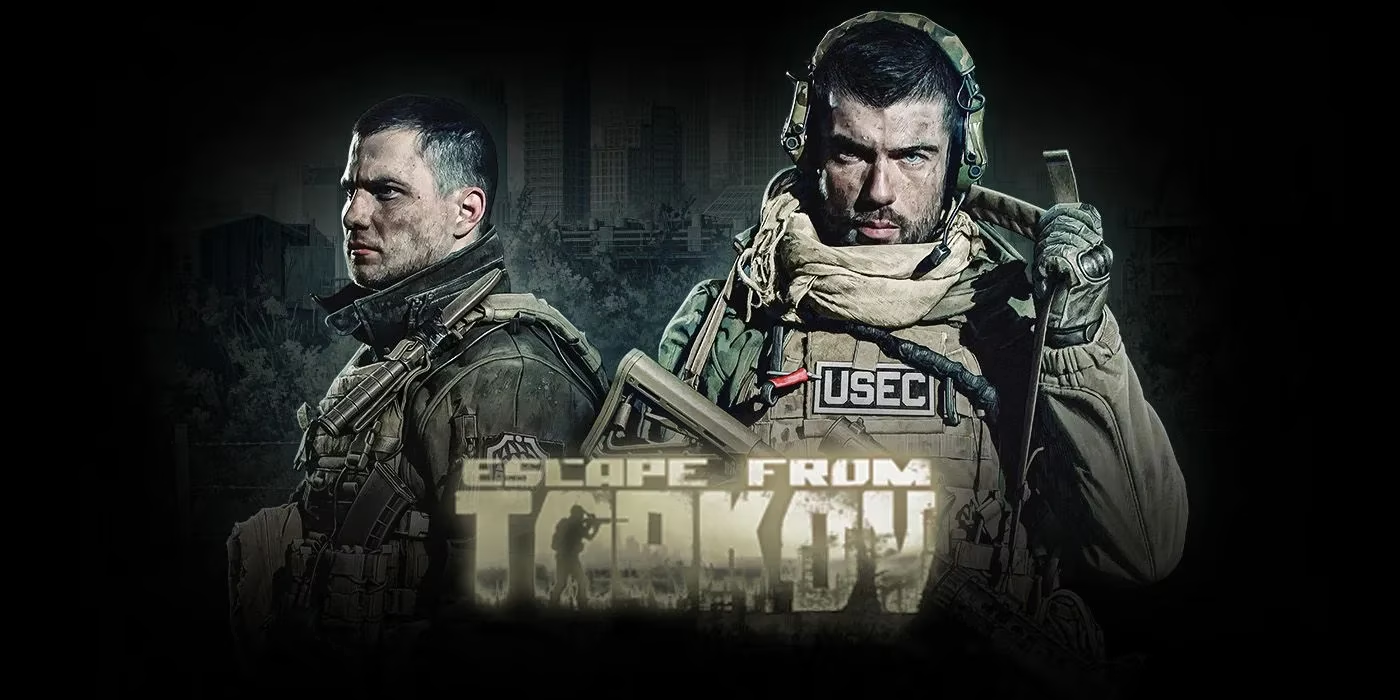
Back in 2021, Tarkov's cheating problem had boiled over into a full-blown public outcry. A Reddit user going by LividFray uploaded a clip that became a rallying cry. It showed their character standing in a hallway, completely out of any enemy's line of sight, yet bullets ripped through walls as if the shooter had X-ray vision. The hacker in question wasn't even trying to hide it—they were, in gamer parlance, pulling a complete ghost mode. LividFray's plea to Battlestate Games was blunt: launch a ban wave, because the cheaters were getting so brazen it was "embarrassing." The community didn't just nod along; they flooded the thread with their own horror stories. One player recalled seeing someone no-clip drift through solid walls like a vengeful poltergeist, looting containers with godlike impunity. Another simply sighed and said they had uninstalled the game after thousands of hours, tired of losing hard-earned kits to phantoms. It was a low point, and you could almost hear the collective groan from Tarkov's player base.
At the time, the sting of a cheat death felt uniquely cruel because Escape From Tarkov isn't your run-of-the-mill battlefield respawn simulator. Die, and every lovingly modded weapon, every rare key, every scrap of high-tier armor you carried simply vanishes from your stash. That mechanic turns every encounter into a heart-pounding gamble, and when the dealer is stacking the deck with zero recoil and wallhacks, the whole game's soul feels tainted. It was, honestly, a total dumpster fire for anyone who played legitimately. Meanwhile, other giants in the genre weren't immune either—Activision's Call of Duty: Warzone had just banned 50,000 accounts in one sweep. But for Tarkov's die-hard fans, seeing Battlestate Games seemingly turn a deaf ear while focusing on maps like Streets of Tarkov felt like a betrayal.
Fast forward to 2026, and the picture has morphed—though not into a perfect postcard. Battlestate eventually rolled up its sleeves. Starting around late 2022, they integrated BattlEye, a third-party anti-cheat system that had proven its mettle in games like Rainbow Six Siege. That move wasn't an instant cure; cheaters simply adapted, crafting hardware-level spoofers and DMA (Direct Memory Access) tools that could waltz past detection. The developer then took a more aggressive internal approach, deploying machine-learning heuristics that analyze player behavior rather than just scanning for known cheat signatures. Ban waves became more frequent, and the communication improved—though many old-timers still say a little more transparency would go a long way.
These days, the cheating landscape in Tarkov is quieter, but don't mistake quiet for silence. The current breed of hacker operates with surgical precision, rarely flying across the map in god mode. Instead, they use subtle "radar"-style cheats to snag all the high-value loot before a round even heats up, or they toggle aim-assist only during clutch moments. If you ask any veteran who's been around since the 2017 alpha, they'll tell you that while the blatant spin-botters are mostly a memory, the underlying distrust can still sour a session. You might still lose a slick loadout to a player who just had "incredible game sense," and that nagging doubt is Tarkov's true endgame boss.
The move to full release—expected by many to happen in 2025—did bring a massive influx of new blood, partially offsetting any player bleed from cheating woes. The Streets of Tarkov map expanded into a true urban labyrinth, and the game's economy continued to evolve with dynamic loot tables that help curb real-money trading, a fuel source for hacking. Battlestate has also started collaborating more openly with content creators and community watchdogs, establishing a reporting system that feeds directly into their automated review processes. Still, the developers walk a tightrope: every new patch introduces fresh vulnerabilities, and a determined cheater can reverse-engineer a bypass in days.
So, is the nightmare over? Not quite, but the beast has been leashed. Escape From Tarkov in 2026 offers a fairer fight than it did five years ago, even if its heart still beats with unforgiving tension. The cheaters have been pushed into the darker corners, and that\u2019s a victory worth acknowledging. Yet, the game\u2019s very nature—a high-stakes environment where losing hurts deeply—will always attract those who\u2019d rather break the rules. Battlestate\u2019s ongoing battle resembles an endless game of whack-a-mole, but at least now the mallet is bigger and the moles are more hesitant. For the players who stuck around through the darkest times, Tarkov finally feels like the brutal-but-fair world they always wanted. As one long-time scav runner puts it with a shrug: "You still die to suspicious stuff, but now you die less often, and that\u2019s enough to keep the faith."
Comments